

Beginning Tantra can feel harder than it needs to. Search results mix traditional ideas, contemporary wellness teaching, relationship programmes, spiritual practice and sensational promises. A beginner may be interested, yet still unsure what to study first or how to recognise a course that fits.
A useful starting point is not a dramatic experience. It is a clear learning decision. What do you want to understand? Which kind of teaching are you comfortable with? How much time can you give to study and reflection? An online tantric course can provide structure, while a holistic wellness course may place that learning within everyday habits, relationships and personal values.
The following roadmap is designed for adults who want to learn Tantra online with realistic expectations. It moves from purpose and course choice to preparation, participation and review, so curiosity becomes an informed practice rather than an impulsive purchase.
Stage One: Write a Personal Learning Brief
Before comparing providers, write three or four sentences about why you are interested in Tantra. Avoid broad goals such as “change my life.” A useful brief names what you want to explore and what you do not want from the experience.
- Interest: Are you drawn to meditation, philosophy, embodiment, relationships, spiritual study, communication or another subject?
- Setting: Do you prefer private solo study, live group learning, one-to-one guidance or a mixture?
- Boundaries: Are there topics, practices or levels of personal disclosure that you do not wish to include?
- Commitment: How many hours can you give each week without displacing sleep, work, care responsibilities or other priorities?
This brief helps separate a genuine learning goal from the attraction of a bold course description. It also gives you useful questions to bring to a provider. Tantra for beginners should leave room for uncertainty; you do not need a complete spiritual identity before the first lesson.
Stage Two: Choose the Teaching, Not the Label
The word Tantra does not guarantee a consistent syllabus. Courses may differ in their historical sources, spiritual perspective, use of movement or meditation, attention to relationships, and treatment of concepts such as subtle energy. Read the curriculum line by line rather than choosing on the basis of a title.
Good tantric education explains what will happen. Look for lesson topics, delivery format, time requirements, instructor access and the role of live sessions. If partner work, touch, nudity, explicit discussion, intensive breathwork or personal disclosure is involved, the provider should say so before enrolment and explain how learners can opt out or adapt.
Teacher fit matters as much as subject matter. A credible educator should be able to describe their training and approach without demanding unquestioning trust. They should welcome practical questions, acknowledge the limits of their role and distinguish spiritual or subjective ideas from medical facts.
A Beginner’s Course Checklist
- Clear scope: The syllabus identifies the ideas and tantric practices being taught and whether they are traditional, adapted or contemporary.
- Transparent format: You know which lessons are recorded, live, solo, partnered or assessed.
- Consent and privacy: Participation choices, group conduct, recordings and personal information are addressed in writing.
- Proportionate claims: The provider describes learning outcomes without promising cures, instant transformation or guaranteed relationship results.
- Defined support: There is a stated route for questions and a clear response if a practice becomes uncomfortable or unsuitable.
- Honest certification: Any certificate’s meaning and limits are explained, particularly for learners considering professional work in the USA or UK.
Stage Three: Prepare for the First Session
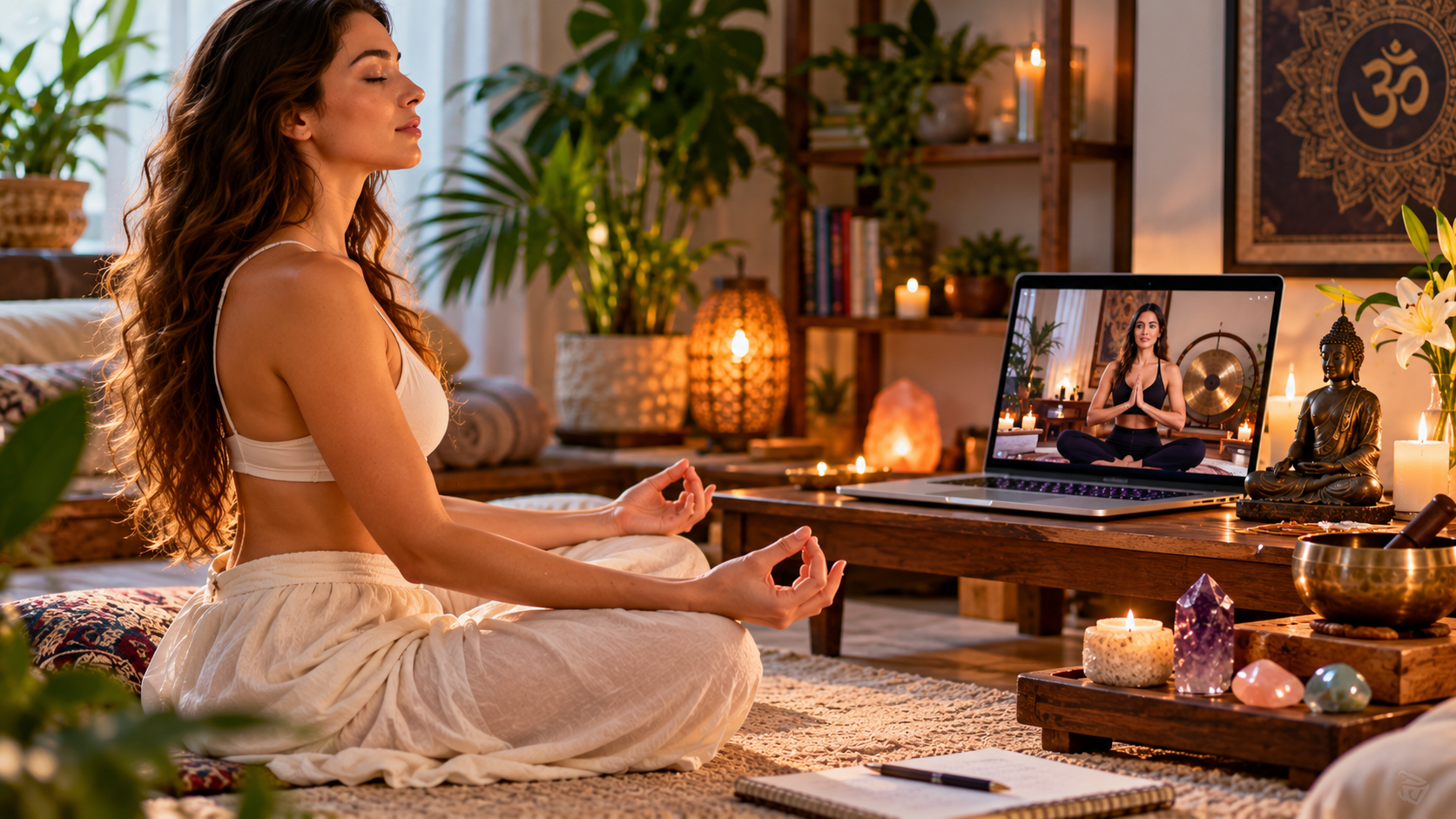
Online Tantra training benefits from a little practical preparation. Read the welcome material, check the technology and choose a private space where you can participate without interruption. Keep water, a notebook and any specified equipment nearby. Comfortable clothing is usually more useful than trying to look the part.
Decide in advance how you will handle an exercise that does not feel right. You might pause, observe instead of participate, ask for an alternative or leave the session. This is not poor commitment. It is a normal use of personal judgment. For health concerns or intensive physical and breathing practices, seek suitable individual advice rather than relying on a general course description.
Set one modest intention for the session, such as understanding a term, noticing how the teaching is structured or identifying a question. Trying to absorb everything at once can make self-discovery feel like another performance task.
Stage Four: Build a First-Month Study Rhythm
A course becomes useful through participation between lessons. During the first month, keep the rhythm simple. Review one lesson, complete the assigned practice if it remains appropriate, and write a few notes. Regular short study periods are often easier to sustain than a large weekend catch-up.
Your notes do not need to interpret every sensation or emotion. Record what was taught, what you actually observed, what meaning you gave it and what you want to ask. Keeping observation separate from interpretation supports clearer self-discovery and reduces the temptation to treat every experience as proof of a spiritual or health claim.
- After each lesson: Write one idea you understood, one point that remains unclear and one way the material may relate to daily life.
- During the week: Choose one manageable course practice and follow the stated guidance rather than combining several unfamiliar methods.
- Before the next session: Review your notes, identify any discomfort or boundary issue and prepare a specific question.
Holistic personal development is easier to assess when it connects with ordinary behaviour. Mindful living might appear as a more deliberate conversation, a clearer limit, better attention during a routine task or a decision to slow down. It does not require constant calm or a dramatic story.
Review the Course After 30 Days
A month is long enough to evaluate the learning process, though not to demand mastery. Return to your original brief and ask whether the course still fits. Are the lessons clear? Are questions answered? Do you feel free to modify or decline? Are the claims becoming more grounded as the course progresses, or more extravagant?
Also consider the practical cost. A programme that repeatedly requires more time, privacy, equipment or additional purchases than advertised may not be sustainable. Continuing a course should be a conscious choice, not an obligation created by money already spent.
If the course is useful, refine your next goal. You may want more historical context, deeper personal practice, a live workshop or further study in tantric wellness. If it is not a fit, leaving can be an informed outcome rather than a failure.
Common Questions From New Learners
Do I Need a Partner to Learn Tantra Online?
Not necessarily. Many introductory courses include theory, reflection, meditation or other solo learning. Others are designed specifically for couples or include partnered exercises. Check the format before enrolling and do not assume that a friend or partner can be added informally; privacy, consent and group rules may apply.
Do I Need to Follow a Particular Spiritual Path?
That depends on the programme. Some courses teach Tantra within an explicitly spiritual or religious framework, while others offer contemporary personal-development material influenced by tantric ideas. Neither should be disguised. Ask how the provider presents its sources, rituals and energy concepts, and whether the approach is compatible with your beliefs.
How Quickly Should I Expect Progress?
There is no responsible universal timetable. Early progress may simply mean understanding the vocabulary, attending consistently, asking better questions or recognising whether the course suits you. Claims of rapid mastery or guaranteed transformation are poor substitutes for a clear curriculum and proportionate learning outcomes.
Exploring a Starting Point With AOMT
AOMT’s overview of learning Tantra discusses online study, gradual learning and the importance of choosing an instructor whose approach fits the learner. Adults can use that overview as one reference point, then review the broader options on the Academy of Modern Tantra website. Confirm current content, delivery, fees, support and participation requirements directly before enrolling.
Approach AOMT as you would any provider: compare the published curriculum with your learning brief, ask specific questions and decide whether the teaching style and boundaries suit you.
Start With Clarity, Then Let Experience Inform You
The beginning of a Tantra journey does not need to be mysterious. Define your purpose, inspect the teaching, prepare your boundaries and give the learning a consistent place in your week. These choices create a stronger foundation than urgency or exaggerated promises.
An online tantric course can introduce ideas and practices in a structured way. A holistic wellness course can help connect that study with mindful living and wider personal development. The right first step is the one you understand, freely choose and can review honestly as you learn.
AOMT provides adult education in Tantra, somatic bioenergetic practice and holistic wellness for personal development and professional interests. Explore its learning pathways at academyofmoderntantra.co.uk.