

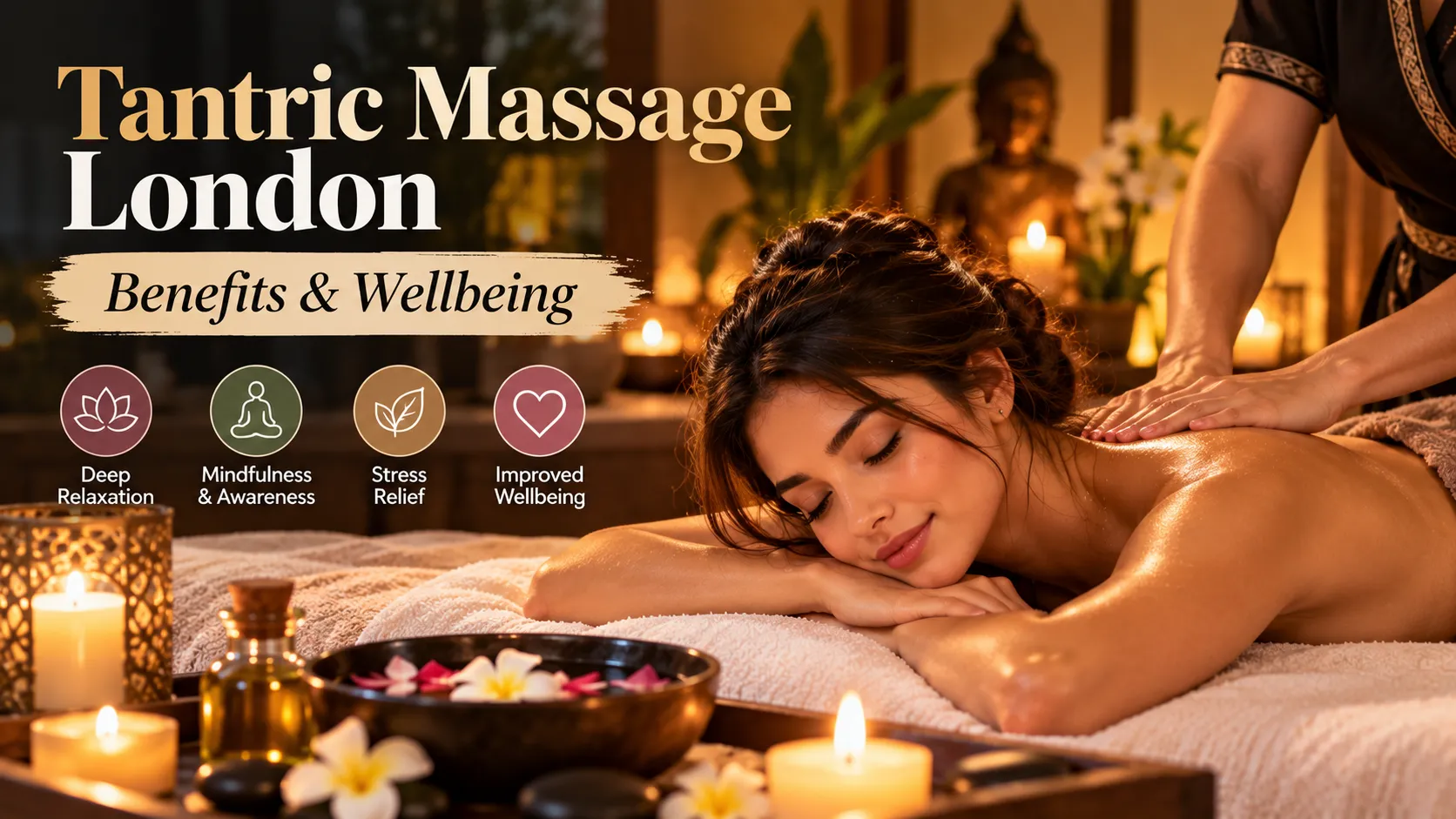
London rarely encourages people to slow down. Commuting, demanding schedules, constant notifications and the simple intensity of moving through a large city can leave little space for deliberate rest. That helps explain why some adults exploring complementary wellness practices become interested in tantric massage in London.
In a modern wellness setting, tantric massage can be understood as a form of mindful bodywork in which massage may be combined with slower pacing, conscious breathing, sensory attention and an emphasis on awareness. Approaches differ considerably between practitioners, so there is no single universal tantric massage routine.
Its potential value is best discussed realistically. People may seek a session for relaxation, physical comfort, greater body awareness, mindful attention or simply dedicated time away from daily pressures. It should not be presented as a cure for physical or psychological illnesses.
Scientific research into massage more generally has identified possible benefits for certain forms of pain and wellbeing, although evidence quality varies and many reported effects are short term. Research specifically proving broad medical benefits from tantric massage is much more limited.
That distinction matters.
A responsible approach to tantric wellness allows space for personal experience without turning subjective benefits into medical promises.
What Is Tantric Massage?
The term covers a variety of contemporary practices rather than one precisely standardised treatment.
A professional session may incorporate familiar elements of massage alongside intentional breathing, slower movements, mindfulness and attention to how different sensations are experienced in the body. Some practitioners also draw inspiration from neo-Tantric ideas about presence, embodied awareness and the relationship between physical experience and attention.
The exact session should always depend on the practitioner, the setting and what has been agreed beforehand.
For someone completely new to the practice, the simplest description is this:
Tantric massage is a slow, awareness-focused approach to bodywork that may combine massage, breath and mindful attention to support relaxation and a stronger sense of connection with the body.
That definition is deliberately broader than many promotional descriptions because modern tantric massage is not a regulated, universally standardised clinical treatment.
A good practitioner should therefore explain what their particular approach includes instead of assuming that every client already knows.
Is Tantric Massage Actually an Ancient Practice?
This is an important distinction that is often overlooked.
Historical Tantra has deep roots in South Asia. Tantric philosophies and practices developed within diverse Hindu and Buddhist traditions from roughly the middle of the first millennium CE and included ritual, meditation, visualisation, yoga and complex religious philosophies.
Contemporary tantric massage, however, should not simply be described as an unchanged ancient Indian massage method.
Academic research into modern Tantra describes substantial transformations during the nineteenth and twentieth centuries, followed by the development of modern or “neo-Tantric” interpretations in Europe and North America.
Modern tantric bodywork can therefore be viewed as inspired by certain Tantric and neo-Tantric ideas rather than identical to historical Tantra itself.
That does not make the modern practice less meaningful. It simply gives people a more accurate understanding of what they are exploring.
Understanding the Benefits Through the REST Framework
A useful way to understand the potential benefits of tantric massage is through four simple ideas:
R — Relaxation: creating deliberate time to slow down.
E — Embodied awareness: noticing sensations and tension more consciously.
S — Sensory mindfulness: directing attention toward the present experience instead of constant mental activity.
T — Trust and boundaries: using clear communication so the session remains comfortable and respectful.
This framework avoids promising miraculous transformation. Instead, it focuses on practical aspects of a session that people can realistically evaluate for themselves.
1. Creating Dedicated Space for Relaxation
One of the most straightforward reasons people book massage is relaxation.
For many Londoners, genuine downtime does not occur automatically. A lunch break becomes another opportunity to check messages. The train home becomes an extension of the working day. Even evenings can remain filled with screens, alerts and unfinished tasks.
Booking a massage creates a defined period during which those demands can temporarily be set aside.
Massage research suggests that some people experience improvements in relaxation, mood or certain symptoms, although results differ according to the population and type of massage studied. The available evidence should therefore be interpreted as supportive rather than proof of a universal response.
Tantric massage may add another dimension by deliberately slowing the pace of the experience.
Instead of rushing from one technique to another, the practitioner may encourage the client to notice breathing, pressure and general bodily sensations.
The benefit is not that the outside world suddenly disappears. It is that the person has temporarily created a quieter environment in which attention can move away from the next meeting, message or obligation.
2. Supporting General Physical Comfort
Massage involves physical contact with muscles and other soft tissues, and many clients book massage because their body simply feels tired, tense or overworked.
Long periods sitting at a desk, commuting, travelling and using phones or laptops may leave people feeling physically uncomfortable even when there is no specific medical condition requiring treatment.
A slower massage session can provide an opportunity to become conscious of areas that feel tense and to experience gentle physical relaxation.
Research on massage has found possible short-term benefits for some types of musculoskeletal pain, including certain back, neck and shoulder complaints, but evidence quality varies. Massage should therefore not be advertised as a cure for chronic pain or used as a substitute for proper assessment when symptoms are persistent or concerning.
For a general wellness client, a more reasonable expectation is straightforward:
You may finish the appointment feeling physically looser, calmer or more comfortable than when you arrived.
That subjective result can be valuable without needing to turn it into a medical claim.
3. Encouraging Slower, More Conscious Breathing
Breathing provides a simple bridge between body awareness and relaxation.
Many contemporary tantric practices incorporate some form of deliberate breathing. The purpose does not need to be mystical or complicated. Paying attention to the breath provides the mind with a clear point of focus and encourages the person to notice whether they are rushing, bracing or holding unnecessary tension.
The NHS recommends gentle breathing exercises as one practical tool people can use when dealing with stress. Its guidance emphasises comfortable, regular breathing without forcing the breath.
A professional tantric massage session may use similarly simple breath awareness as part of a slower atmosphere.
There is no need to promise that special breathing patterns will “reset” the nervous system or instantly change someone’s health.
The useful principle is much simpler: slowing down enough to notice your breathing can make it easier to remain present and settle into the experience.
4. Developing Greater Body Awareness
Modern life encourages people to spend enormous amounts of time inside their thoughts.
Emails, schedules, planning and digital communication continually demand cognitive attention. As a result, it can be surprisingly easy to ignore ordinary signals from the body.
You may not realise your shoulders have tightened until the working day finishes.
You may discover that you have been sitting in one position for several hours.
You may notice that your breathing becomes shallow whenever you are concentrating.
Tantric massage places deliberate attention back on physical sensations.
Rather than trying to ignore the body, the person is encouraged to notice it.
This is sometimes described as embodied awareness.
For one client, that may mean noticing where they habitually hold tension. For another, it may simply mean recognising which pressure feels comfortable and which does not.
The goal is not to diagnose hidden problems. It is to become a more attentive observer of your own physical experience.
That awareness can also improve communication with a therapist because the client becomes more comfortable saying, “lighter pressure,” “that area feels tense,” or “I would prefer to avoid that area.”
5. Providing a Form of Sensory Mindfulness
Mindfulness is often associated with sitting meditation, but present-moment attention can be practised in many ways.
During bodywork, attention has something concrete to follow: breathing, pressure, warmth, movement, music or simply the sensation of lying still.
These sensory cues can function as anchors for attention.
When the mind wanders toward tomorrow’s workload or yesterday’s conversation, awareness can return to what is actually happening in the room.
This does not mean massage is a treatment for anxiety or another mental health condition.
It means that the structure of a quiet session can create circumstances in which mindful attention may feel more accessible.
For someone who struggles to sit still for twenty minutes of formal meditation, an embodied practice can offer another way of exploring what being present actually feels like.
6. Building Better Awareness of Personal Boundaries
Professional boundaries are not a minor detail in tantric massage. They are fundamental to whether the experience feels trustworthy.
A good appointment begins with communication.
The practitioner should explain the session clearly enough that the client knows what kind of bodywork is being offered, how long it lasts and how comfort preferences can be communicated.
The client should remain able to request a change in pressure, pause the session or decline something that does not feel appropriate.
That process can have value beyond the treatment room.
People sometimes find that explicitly identifying what feels comfortable helps them become clearer about their own preferences generally.
This should not be exaggerated into claims about psychological transformation. It is simply one practical advantage of working with a practitioner who treats communication as part of professional care rather than an interruption to it.
7. Creating an Intentional Self-Care Ritual
Wellbeing habits are often effective because they create predictable moments of pause.
Some people run.
Others practise yoga, meditate, visit a sauna, spend time outdoors or book occasional massage.
Tantric massage can occupy a similar position for someone who enjoys mindful bodywork.
The session creates a beginning and an end.
You stop working.
You put your phone away.
You enter a different environment.
You allow yourself to focus on one experience rather than several competing tasks.
That ritual can be meaningful even if no dramatic event occurs.
In fact, expecting every wellness appointment to produce a life-changing breakthrough can make relaxation more difficult.
A healthier expectation is simply to give yourself time to slow down and observe how your body responds.
8. Complementing a Broader Wellness Routine
Tantric massage does not need to function in isolation.
Someone interested in holistic wellbeing may also explore ordinary exercise, yoga, meditation, better sleep routines, breathing exercises, counselling where appropriate, or other evidence-informed forms of self-care.
The most sustainable approach is rarely to search for one practice that promises to fix everything.
Instead, different activities can serve different purposes.
Massage may be the practice you use for physical relaxation.
Yoga may provide movement and mobility.
Breathing exercises may become something you use during stressful parts of the day.
A therapist or wellness practitioner should also understand the limits of their role. When a health problem requires medical or psychological expertise, complementary bodywork should remain complementary.
Why Tantric Massage Appeals to People in London
The appeal of tantric massage in London makes particular sense when considered against the pace of city life.
London residents and visitors often balance long travel times, demanding professional schedules and a large amount of sensory stimulation. Finding private, uninterrupted time for yourself can become surprisingly difficult.
Location therefore matters.
Some people prefer an in-call studio because physically leaving home or work creates a clean break from daily responsibilities.
Others prefer the convenience of an outcall arrangement where available.
TantricMassageLondon.net currently lists multiple massage locations across London as well as in-call and outcall options, making geography part of the selection process rather than an afterthought. Availability and individual practitioner locations should always be confirmed when booking.
The right format is ultimately the one that helps you feel comfortable, unrushed and clear about what to expect.
How to Evaluate the Best Tantric Studio in London for Your Needs
People frequently search Google for the best tantric studio in London, but “best” is not a universal quality.
A studio that suits one person’s preferences may not suit another’s.
Instead of relying entirely on promotional claims, evaluate the experience through a CLEAR checklist:
- Communication: Are your questions answered clearly before you book?
- Limits: Does the practitioner respect boundaries and explain what the session involves?
- Environment: Does the studio appear private, clean and professionally maintained?
- Approach: Is the practitioner able to explain their style without making unrealistic medical promises?
- Reputation: Are therapist information, contact details, policies and relevant reviews easy to find?
These criteria are considerably more useful than phrases such as “number one,” “ultimate” or “London’s best” when those claims cannot be independently demonstrated.
Transparency is especially important.
Before attending, you should be able to establish the session duration, price, location and practitioner.
A professional provider should also be comfortable answering practical questions about hygiene, massage products, comfort and any relevant policies.
Your website already provides individual therapist profiles, current location information and a dedicated pricing section, so this article should send users to those resources rather than duplicating information that could change.
How to Choose Among Massage Therapists in London
Searches for the most popular massage therapists in London may seem like the easiest way to choose, but popularity alone tells you relatively little about personal suitability.
A practitioner with the most reviews or strongest social-media presence is not automatically the right practitioner for every client.
Look instead for compatibility and professionalism.
Read the person’s profile.
Consider their stated approach and location.
Ask what style of massage they specialise in.
Confirm that the communication makes you feel comfortable before committing to an appointment.
Professional selection becomes particularly important with any form of bodywork involving a high level of personal trust.
Your site’s dedicated guide to choosing a tantric massage therapist already goes deeper into professional standards, communication and boundaries, making it an ideal supporting resource for readers who have reached this stage of the decision process.
What Is the Relationship Between Tantric Yoga and Tantric Massage?
Tantra and yoga have intersected historically, but neither subject should be reduced to massage.
Historical Tantra encompassed broad religious and philosophical traditions and incorporated practices such as ritual, visualisation and forms of yoga. The British Museum notes that Hatha yoga became connected with Tantric practice during Tantra’s development in South Asia.
Modern Tantric yoga can mean different things depending on the teacher and tradition.
Some contemporary practices may emphasise breathing, movement, meditation or energetic concepts. Others may draw more heavily from modern neo-Tantric interpretations.
Tantric massage is different because the central experience is bodywork provided by a practitioner.
The two may share concepts such as breath awareness, attention and embodiment, but they should not be presented as identical practices.
Anyone interested in this relationship can explore the site’s dedicated Tantra and Yoga comparison for a deeper discussion.
Where Do Holistic Wellness Courses Fit?
People who become interested in meditation, Tantra, body awareness or mindful massage sometimes begin researching holistic wellness courses.
The quality of those courses can vary enormously.
Before enrolling, examine the syllabus, instructor background, learning outcomes and whether the course accurately distinguishes spiritual or experiential teachings from medical science.
Be cautious around programmes that promise to cure diseases, heal serious trauma without qualified clinical support or provide guaranteed psychological transformation.
A credible wellness education programme should be comfortable acknowledging what it teaches—and what lies outside its professional scope.
For TantricMassageLondon.net, this keyword would be better developed through a future dedicated educational resource or genuine course page rather than inserted repeatedly into a massage-benefits article.
How to Prepare for Your First Tantric Massage in London
Preparation does not need to be elaborate.
Start by reading the therapist profile and service description rather than arriving with assumptions based on another studio or something you have seen online.
Confirm the time and location.
Check the price and duration.
Ask questions beforehand if anything is unclear.
Think about comfort preferences or areas of physical sensitivity you need to mention.
Avoid constructing a detailed expectation of exactly how you are supposed to feel.
Some people finish massage feeling deeply relaxed.
Others simply feel pleasantly rested.
Occasionally, someone may realise that the style is not particularly suited to them.
All of those responses are valid.
A first session is partly an opportunity to discover whether you actually enjoy this type of bodywork.
Most importantly, communicate.
If you would like lighter pressure, say so.
If you are uncomfortable, say so.
If you need the practitioner to explain something, ask.
Professional massage should not depend on the client remaining silent when something needs adjusting.
What Should You Do After a Session?
Give yourself a few minutes before immediately returning to a demanding schedule where possible.
Drink normally according to thirst, eat if needed and notice how you feel.
There is no requirement to undertake complicated “detox” routines.
You might simply take a short walk, continue your day at a slower pace or make a note of what you found most relaxing.
If you plan another appointment, that information can help you communicate your preferences more clearly next time.
Wellness becomes more useful when you pay attention to your actual experience instead of trying to recreate somebody else’s.
Safety and Realistic Expectations
Massage is generally regarded as relatively low risk when provided appropriately, but “low risk” does not mean that massage is suitable for every person or every situation.
NCCIH notes that serious adverse effects from massage are rare but have been reported, particularly with vigorous forms of massage or individuals who may be at increased risk of injury. It recommends discussing massage with a healthcare provider when you are unsure whether it is appropriate and specifically advises against using massage to postpone medical care.
If you have an injury, unexplained pain, an important medical condition or another reason to question whether massage is suitable, seek appropriate medical advice.
The same principle applies psychologically.
A massage practitioner is not automatically a counsellor, psychotherapist or trauma specialist.
Bodywork can sometimes bring up unexpected emotions simply because a quiet environment gives people space to notice how they feel. That should not automatically be interpreted as trauma being “released from the tissues.”
If difficult emotions are persistent or significantly affect daily life, appropriate mental-health support is more suitable than relying on massage alone.
Responsible wellness means knowing when bodywork is useful and when another professional is needed.
Who Might Enjoy Tantric Massage?
Tantric massage may appeal to adults who enjoy massage but want something slower and more awareness-focused.
It may also suit people who are curious about mindfulness but prefer an embodied practice to conventional seated meditation.
Others may simply want a private break from a demanding London routine.
There is no requirement to adopt a particular spiritual belief.
There is also no requirement to experience a dramatic energetic or emotional response.
The value of the session should be judged by what it actually provides for you: comfort, relaxation, mindful attention, or simply enjoyable time devoted to yourself.
Frequently Asked Questions About Tantric Massage in London
What are the main benefits of tantric massage?
Potential benefits are most responsibly described as relaxation, body awareness, sensory mindfulness, physical comfort and deliberate time away from everyday pressures. Broader massage research suggests possible benefits for certain symptoms, but tantric massage should not be presented as a medical cure.
Is tantric massage scientifically proven?
There is scientific research into massage therapy generally, but evidence varies according to the condition, massage style and outcome being studied. There is far less high-quality evidence establishing unique medical benefits specifically for tantric massage. Experiential wellness claims should therefore remain separate from clinical claims.
Can tantric massage reduce stress?
Some people find massage relaxing, and creating a quiet environment combined with slow breathing may help them feel calmer. NHS guidance also recognises gentle breathing exercises as one practical strategy for stress. Massage should not, however, be positioned as a treatment for an anxiety disorder or other mental-health condition.
Is tantric massage the same as traditional Tantra?
No. Historical Tantra includes diverse religious and philosophical traditions with roots in South Asia. Contemporary tantric massage developed within a much more modern context and often reflects neo-Tantric interpretations.
Is tantric massage the same as Tantric yoga?
No. They may share concepts such as breathing, attention and embodiment, but yoga centres on practices performed by the practitioner themselves, while massage involves bodywork provided by another practitioner. Individual schools may define both terms differently.
How do I find a good tantric massage therapist in London?
Look for clear therapist information, transparent communication, appropriate boundaries, hygiene standards, clearly stated pricing and an approach that does not rely on unrealistic medical promises. Compatibility matters more than popularity alone.
Should I choose an in-call or outcall massage?
It depends on your circumstances. Some people prefer travelling to a dedicated environment because it separates the experience from everyday life. Others value the convenience of an outcall appointment. Confirm current locations and availability before booking.
How often should I book tantric massage?
There is no medically established schedule that applies to everyone. Frequency should depend on personal preference, budget, how your body responds and why you are booking. You do not need frequent sessions in order to validate the experience.
Can tantric massage cure pain or health problems?
It should not be advertised as a cure. General massage research suggests possible short-term benefits for some pain conditions, but evidence quality differs and persistent or unexplained symptoms should be assessed appropriately.
What should I ask before my first appointment?
Confirm the therapist, session duration, location, current price, general style of bodywork and anything you need to know regarding comfort or preparation. If you have a health concern that could affect whether massage is appropriate, speak with an appropriate healthcare professional.
Explore Tantric Massage in London With Clear Expectations
The strongest reason to explore tantric massage is not because someone promises a miraculous transformation.
It is because you are curious about a slower, more mindful approach to bodywork and want to discover how it feels for you.
A well-run experience should place professionalism, comfort, communication and personal choice at the centre of the session.
For people living or staying in London, that means choosing a practitioner whose approach suits you, selecting a convenient location and entering the experience with realistic expectations.
TantricMassageLondon.net provides therapist profiles and London location information so you can compare current options before deciding what feels appropriate.
Explore the available therapists, review the locations and choose an experience that allows you to slow down on your own terms.