

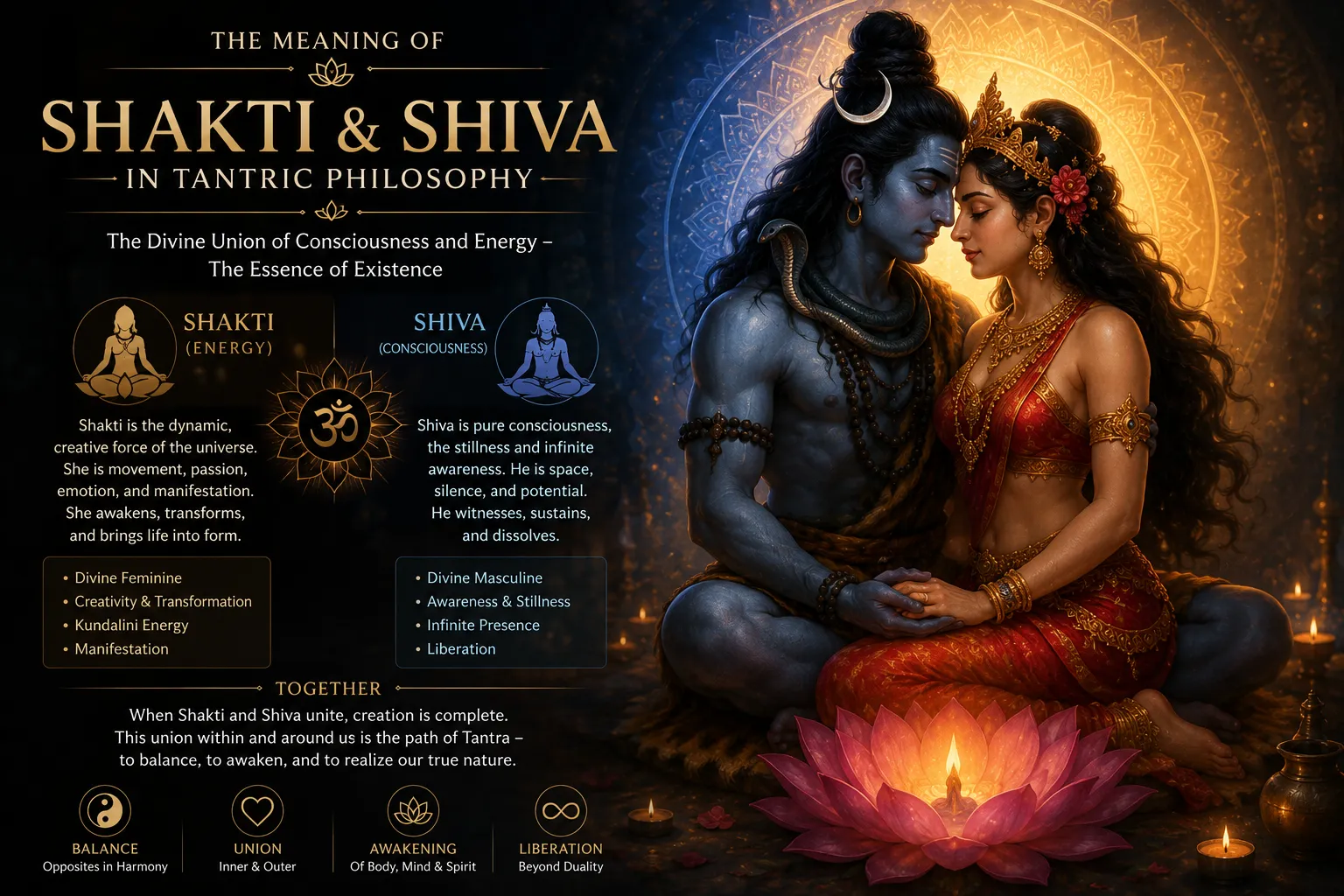
In an influential strand of tantric philosophy, Shiva represents the luminous awareness through which experience is known, while Shakti represents its power to move, create and take form. They are not two competing forces. Their union expresses a deeper idea: awareness and its capacity for expression are distinguishable, yet never truly separate.
This explanation is a useful starting point, not a definition of every tantric tradition. Hindu and Buddhist tantric schools developed different texts, rituals and philosophies. The Oxford Handbook of Tantric Studies stresses that tantra is a diverse field whose traditions cannot be reduced to one universal system.
What does Shiva mean?
Shiva is both a major Hindu deity and, in some non-dual Shaiva philosophies, a name for fundamental consciousness. In this philosophical use, Shiva is not simply a male personality. The term points towards the capacity to be aware: the still, illuminating presence in which thoughts, sensations and actions become known.
Stillness does not mean lifelessness or withdrawal from the world. It describes the receptive aspect of experience. Before a person can respond thoughtfully, they must first notice what is happening. Shiva therefore offers a symbol for presence without immediate reaction.
What does Shakti mean?
The Sanskrit word shakti means power or capacity. Shakti may be worshipped as the Goddess, and she also signifies the dynamic potency through which consciousness appears as thought, movement, language, sensation and the manifest world.
If Shiva names awareness, Shakti names what awareness can do. She is not merely an accessory to a more important masculine principle. In Shakta traditions, divine power and the Goddess occupy the centre of theology and practice. The University of Chicago Press overview of The Hindu Tantric World also shows why tantra must be understood through its philosophical and ritual depth, not reduced to its popular Western associations.
Why their union matters
Shiva and Shakti are frequently presented through gendered imagery, but treating them as fixed descriptions of men and women misses the philosophical point. Every person can experience quiet awareness and active expression. Neither quality belongs exclusively to one sex, personality or relationship role.
Their union can be understood through a simple three-part relationship:
- Awareness: noticing an experience without rushing to label it.
- Power: having the capacity to respond, create or change.
- Integration: allowing action to arise from clear attention rather than habit.
Without awareness, action can become automatic. Without expression, awareness remains only potential. Their relationship suggests that a complete experience involves both presence and participation.
How the idea appears in modern practice
Modern teachers use Shiva and Shakti in varied ways, so the language should never be assumed to mean the same thing in every class or session. Tantra Yoga, for example, may combine philosophical study with meditation, posture, mantra or breath awareness, depending on the teacher and lineage.
Contemporary wellness services may use the pair more practically. Someone considering Tantric Massage in London might interpret Shiva as attentive presence and Shakti as the responsive movement of the session. That is a modern application, not proof that a commercial appointment reproduces a historical tantric ritual.
The distinction protects both cultural accuracy and client choice. A responsible provider should explain which ideas influence its approach, what the actual service includes and which elements are optional. Spiritual language must never replace a clear consultation, active consent or professional boundaries.
Bringing the philosophy into a London appointment
The most useful connection is not a promise of awakening or invisible energy change. It is a practical rhythm between noticing and responding. A client notices pressure, temperature, pace or uncertainty, then communicates. The practitioner listens and adapts within the agreed service.
Among options described as the most popular Tantric Massage parlour in London, favour a setting that answers practical questions before asking for commitment. Privacy, hygiene, therapist information and the freedom to revise a preference are more meaningful indicators of personal suitability.
For your needs, the best tantric studio in London may be the one whose location, communication and approach make informed choice easiest. One adult may value a convenient incall setting, while another prioritises a particular therapist or clearer preparation guidance.
The massage overview explains the site’s broad approach. First-time visitors can also consult the frequently asked questions and turn an abstract interest into specific points to discuss before booking.
A balanced understanding
Shiva and Shakti are better understood as a relationship than as opposing labels. In one influential tantric reading, Shiva is awareness and Shakti is its living power. Their inseparability reminds us that presence is not passive, and action becomes more meaningful when it is informed by attention.
For modern London readers, that idea can support a grounded approach to wellbeing without making religious, medical or guaranteed claims. Learn from the philosophy with respect, ask how a provider applies it, and keep personal choice central throughout the experience.
To discuss a private adult appointment with clear expectations, contact Tantric Massage London.
Sources
The historical framing in this article is informed by the Oxford Handbook of Tantric Studies and André Padoux’s scholarly overview, The Hindu Tantric World.