

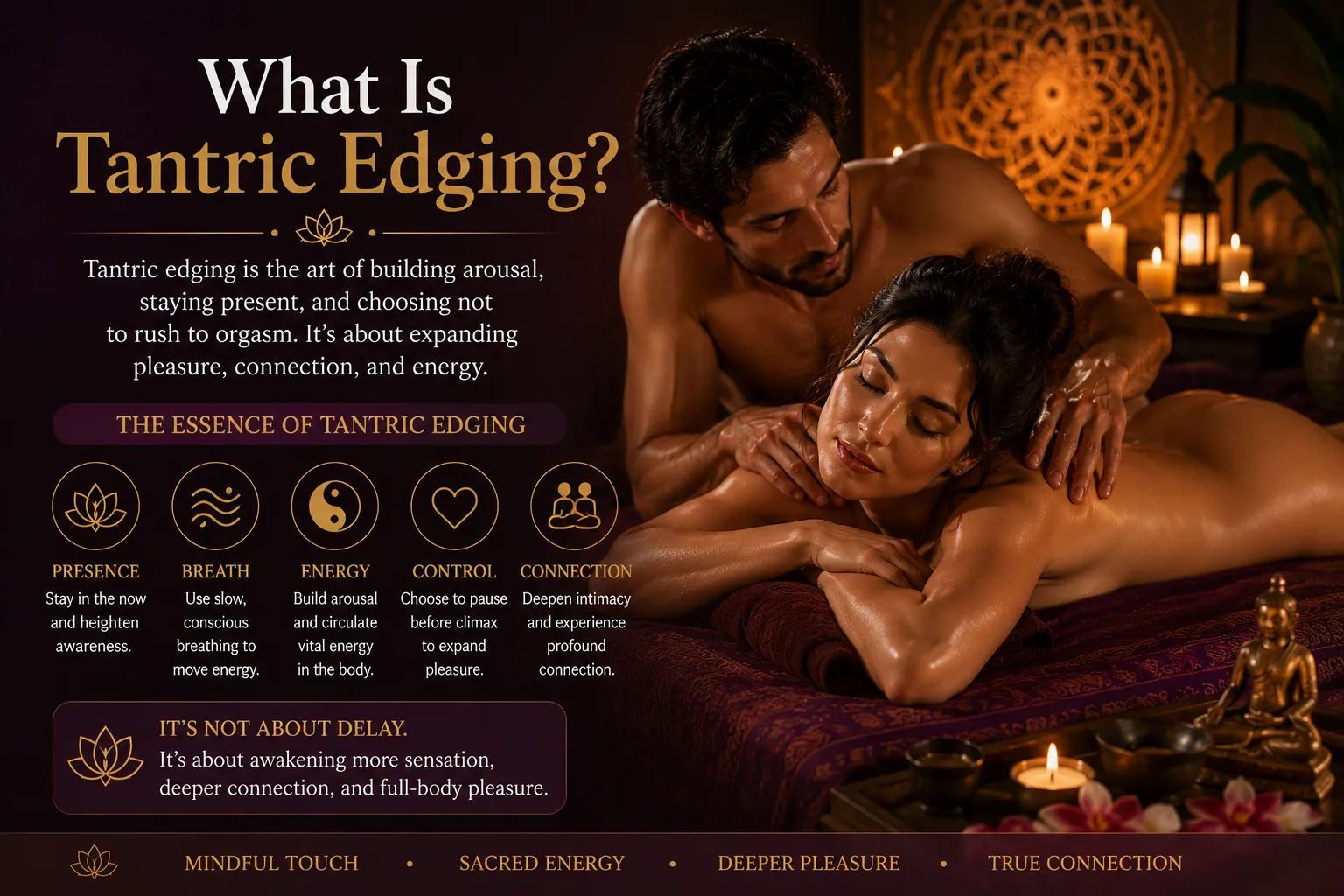
Tantric edging is a modern adult practice that combines changes in arousal pace with deliberate pauses, breathing and close attention to physical and emotional responses. Rather than rushing towards a predetermined finish, the emphasis is on noticing what changes as intensity rises or settles. It must always be voluntary, clearly discussed and easy to stop.
The word “tantric” can make the idea sound ancient or mysterious. In reality, Tantra includes many Hindu and Buddhist traditions, with different texts, rituals and aims. Modern intimate practices may borrow themes such as awareness, breath and embodied attention, but they should not be presented as one universal technique taken directly from historical Tantra.
The Difference Between Edging and Tantric Edging
Edging usually refers to deliberately approaching a high level of arousal and then reducing or pausing stimulation. The tantric version adds a broader field of attention. Breathing, muscle tension, emotion, communication and the urge to reach a result all become part of what the person notices.
This change of emphasis matters. The purpose is not to prove stamina or guarantee a stronger response. It is to explore pace without turning the experience into a performance test. Some adults may find the slower rhythm engaging, while others may prefer a different approach. Neither response is a failure.
A Four-Part Choice Loop
The safest way to understand the practice is as a loop of decisions rather than a fixed sequence. Every stage can be changed or ended.
1. Agree on the intention
Before any shared adult practice, both people should understand what is being proposed. One person may be curious about mindful pacing, while another may simply want an unhurried experience. No particular outcome should be promised or assumed.
2. Choose simple signals
Clear words such as “continue”, “slower”, “pause” and “stop” are more reliable than expecting someone to interpret body language. Consent is an ongoing conversation, not permission granted once at the beginning. A pause should be accepted immediately and without persuasion.
3. Notice the whole response
Attention can move beyond intensity alone. Is the breathing comfortable? Is the body becoming tense? Does the person feel present, distracted or under pressure? These observations help keep the experience responsive instead of mechanical.
4. Adjust, continue or finish
The next step depends on current comfort, not the original plan. Continuing, changing direction or ending are all valid choices. This freedom is the practical centre of the method.
Is Tantric Edging Part of Tantra Yoga?
This term generally refers to broader systems of contemplative, ritual or embodied practice. Depending on the school, these may involve meditation, mantra, visualisation, breath or work with philosophical concepts. It should not be treated as another name for edging.
The connection is therefore interpretive rather than automatic. A modern practitioner may bring patient attention and breath awareness into an intimate setting, but that does not turn the activity into a traditional rite or represent every tantric lineage.
What It Means in a London Massage Setting
Anyone researching Tantric Massage in London should ask what a provider actually offers rather than relying on suggestive labels. A professional description should explain the general format, privacy arrangements, boundaries and opportunities to ask questions before the appointment.
The phrase most popular Tantric Massage parlour in London is not proof of suitability. Popularity cannot tell you whether communication feels respectful, whether the environment meets your hygiene expectations or whether the advertised scope is clear.
Likewise, a claim to be the best tantric studio in London should be tested against practical evidence. Review the provider’s massage information, compare the therapist profiles and read the frequently asked questions. Confirm any personal requirement directly because profiles, locations and availability can change.
Boundaries Matter More Than Technique
Tantric edging is appropriate only for consenting adults who understand the proposed activity and remain free to change their minds. No therapist or partner should treat a physical response as consent, continue after a stop request or make a client feel responsible for reaching a particular result.
The practice is also not a medical treatment for concerns about arousal, orgasm or ejaculation. Anyone experiencing persistent difficulty, pain, numbness or distress should seek advice from an appropriately qualified healthcare professional rather than relying on a massage technique.
A More Useful Definition
Tantric edging can be understood as mindful variation in pace, supported by communication and regular choice. Its value, when adults choose it freely, lies in attentive exploration rather than a guaranteed destination. The most important measure is not how long an experience lasts, but whether every stage remains comfortable, transparent and consensual.
For help understanding the available massage formats and setting expectations before an appointment, contact Tantric Massage London.